Saturday, November 30, 2019

HSK 1: Vocabulary 91-100 | Let's read all the Chinese words in HSK 1 汉语水平考試 HSK 1-with flashcards


91.
少little; few (adj.) shǎo
教室里的学生很少。
教室裡的學生很少。
jiào  shì  li  de  xué  shēng  hěn  shǎo 
There are few students in the classroom.
[教室jiào  shì: classroom]

92.
谁/誰who- shuí
你的汉语老师是谁?
你的漢語老師是誰?
nǐ  de  hàn  yǔ  lǎo  shī  shì  shuí  ?
Who is your Chinese teacher?
[谁的shuí de: whose –
这是谁的杯子? zhè  shì  shuí  de  bēi  zi  ? Whose cup is it?]

93.
什么/什麼What- shén  me
你的经理叫什么名字?
你的經理叫什麼名字?
nǐ  de  jīng  lǐ  jiào  shén  me  míng  zi  ? 
What is your manager’s name?
[叫jiào: call –
我叫理查wǒ  jiào  lǐ  chá: I am called Richard-> My name is Richard]

94.
十ten- shí
今天是十月十号。
今天是十月十號。
jīn  tiān  shì  shí  yuè  shí  hào  。
It is October tenth today.

95.
时候/時候moment; time (n.)- shí  hòu 
是时候睡觉了。
是時候睡覺了。
shì  shí  hòu  shuì  jiào  le  。
It’s time to sleep.
[You can also say: 睡觉的时候到了。shuì  jiào  de  shí  hòu  dào  le]
[了le: can also be a marker to show a request/an order]

96.
是like the “Be-verb” in English (v.) - shì
她哥哥是一位中文老师。
她哥哥是一位中文老師。
tā  gē  ge  shì  yí  wèi  zhōng  wén  lǎo  shī  。 
Her elder brother is a Chinese teacher.
[她(的)哥哥tā (de) gē  ge: We can omit 的 when talking about family members]

97.
书/書book (n.) shū
妹妹很喜欢这本故事书。
妹妹很喜歡這本故事書。
mèi  mei  hěn  xǐ  huān  zhè  běn  gù  shì  shū  。
My sister likes this storybook very much.
[ 本běn: a measure word for books or magazines.]

98.
水water (n.) shuǐ
我口很渴。我喝了三杯水。
我口很渴。我喝了三杯水。
wǒ  kǒu  hěn  kě  。  wǒ  hē  le  sān  bēi  shuǐ  。 
I was very thirsty. I drank three cups of water.
[ 了le: also a marker for past tense.]


99.
水果fruit (n.) shuǐ  guǒ 
爸爸昨天吃了面条和水果。
爸爸昨天吃了麵條和水果。
bà  ba  zuó  tiān  chī  le  miàn  tiáo  hé  shuǐ  guǒ  。
Father ate noodles and fruit yesterday.
[ 了le: a marker for past tense.]

100.
睡觉/睡覺sleep (v.) shuì  jiào
妈妈昨晚没睡觉。
媽媽昨晚沒睡覺。
mā  ma  zuó  wǎn  méi  shuì  jiào  。 
Mother didn’t sleep last night.
[ 没méi + VERB: a negative maker for a verb]
----------------------------
Q1
少   十  谁
少  十  誰  
坐在椅子上的男孩是__?
坐在椅子上的男孩是__?
zuò  zài  yǐ  zi  shàng  de  nán  hái  shì  __  ?
___ is the boy sitting on the chair?

Q2
水果   睡觉  书
水果  睡覺  書    
黄先生早上买了一本中文__。
黃先生早上買了一本中文__。
huáng  xiān  shēng  zǎo  shàng  mǎi  le  yì  běn  zhōng  wén  __  。
Mr. Huang bought a Chinese ___ in the morning.

Q3
水   时候  什么
水  時候  什麼    
吃午饭的__到了。
吃午飯的___到了。
chī  wǔ  fàn  de  __  dào  le  。 
It’s __ to eat lunch.

Q4
十    九    七
十   九   七
六加四等于__。
六加四等於___。
liù  jiā  sì  děng  yú  __  。 
Six and four is ____.
[加jiā: add; 等于děng  yú: to equal]

Q5
水    少    是
水   少   是
理查__我的中文老师。
理查___我的中文老師。
lǐ  chá  __  wǒ  de  zhōng  wén  lǎo  shī  。 
Richard ___ my Chinese teacher.

Collocations(simplified):
[1] 喝___     (A) 谁
[2] 吃___       (B) 十
[3] 看___       (C) 书
[4] ___块钱     (D) 水果
[5] 他是___?     (E) 水

Collocations(traditional):
[1] 喝___        (A) 誰
[2] 吃___         (B) 十
[3] 看___         (C) 書
[4] ___塊錢          (D) 水果
[5] 他是___?        (E) 水

Wednesday, November 27, 2019

Daily Chinese Idioms 成语(chéng yǔ) [7] | Interesting and Common Chinese Idioms | 中文趣味成语- with flashcard


1.
五音不全 [adj.]  wǔ  yīn  bù  quán
五音不全
bad at singing; unable to sing in tune
[Here, 音yīn means 音调yīn  diào: musical tune]

A: 理查唱歌真是五音不全。
B: 真的,他唱歌真难听。
A: 理查唱歌真是五音不全。
B: 真的,他唱歌真難聽。
A: lǐ  chá  chàng  gē  zhēn  shì  wǔ  yīn  bù  quán  。 
B: zhēn  de  ,  tā  chàng  gē  zhēn  nán  tīng  。
A: Richard is really bad at singing.
B: True, his singing is really terrible.

2.
一扫而空[v.] yì  sǎo  ér  kōng
一掃而空
sweep away [emotions] /buy up [products]
clear off [obstacles]/polish off [food]

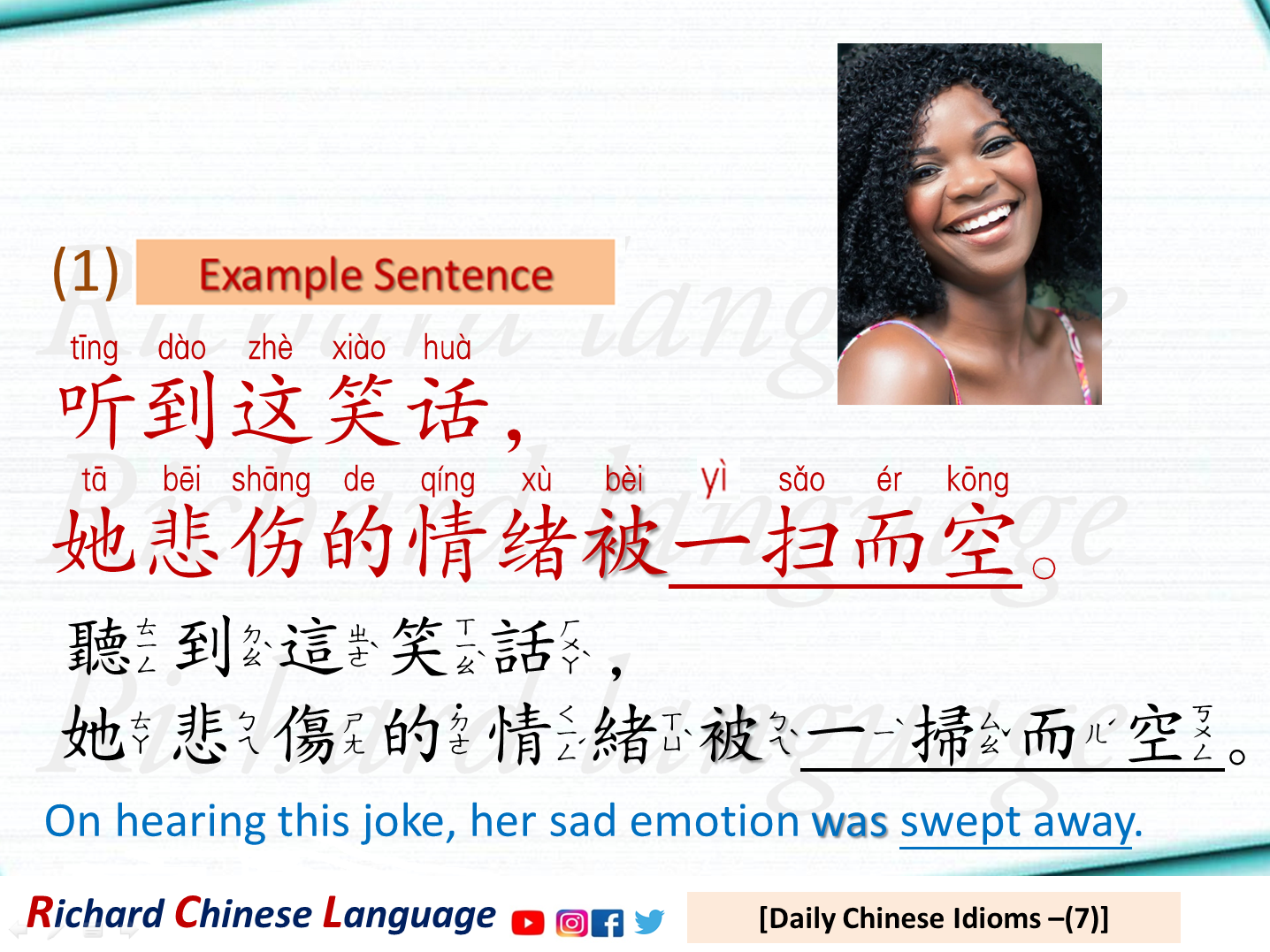
(1)
听到这笑话,她悲伤的情绪被一扫而空。
聽到這笑話 ,她悲傷的情緒被一掃而空。
tīng  dào  zhè  xiào  huà  ,  tā  bēi  shāng  de  qíng  xù  bèi  yì  sǎo  ér  kōng  。
On hearing this joke, her sad emotion was swept away.

(2)
好吃的手工蛋糕马上被一扫而空。
好吃的手工蛋糕馬上被一掃而空。
hào  chī  de  shǒu  gōng  dàn  gāo  mǎ  shàng  bèi  yì  sǎo  ér  kōng  。
The delicious home-made cake was polished off immediately.

3.
密不可分 [adj.] mì  bù  kě  fēn
密不可分
inseparable; closely linked  [esp. relationship]

失业和贫穷之间的关系密不可分。
失業和貧窮之間的關係密不可分。
shī  yè  hé  pín  qióng  zhī  jiān  de  guān  xì  mì  bù  kě  fēn 
The relationship between unemployment and poverty is inseparable.

4.
难以置信 [adj.] nán  yǐ  zhì  xìn
難以置信
hard to believe; far-fetched; unbelievable

真令人难以置信,她通过了HSK 6级考试。
真令人難以置信, 她通過了HSK 6級考試。
zhēn  lìng  rén  nán  yǐ  zhì  xìn  ,  tā  tōng  guò  le  HSK  6  jí  kǎo  shì  。 
It’s unbelievable. She passed HSK 6.

5.
烫手山芋 [n.] tàng  shǒu  shān  yù
燙手山芋
a hot potato; a problem that is very difficult to handle

这场罢工对政府而言是个烫手山芋。
這場罷工對政府而言,是個燙手山芋。
zhè  chǎng  bà  gōng  duì  zhèng  fǔ  ér  yán  shì  ge  tàng  shǒu  shān  yù  。
This strike is a hot potato for the government.

Q1
(A)五音不全       (B) 难以置信  
(C) 密不可分      (D)烫手山芋
(E) 一扫而空
真令人___。这位墨西哥人的汉语说得真好。 
真令人__。這位墨西哥人的漢語說得真好。
zhēn  lìng  rén  __  。  zhè  wèi  mò  xī  gē  rén  de  hàn  yǔ  shuō  de  zhēn  hǎo  。 
It’s ___. This Mexican speaks Chinese so well.

Q2
(A)五音不全       (B) 难以置信  
(C) 密不可分      (D)烫手山芋
(E) 一扫而空
语言与文化(之间)___。 
語言與文化(之間)____。
yǔ  yán  yù  wén  huà  (  zhī  jiān  )  __  。
It’s ___ (between) language and culture.

Q3
(A)五音不全       (B) 难以置信  
(C) 密不可分      (D)烫手山芋
(E) 一扫而空
我叔叔唱歌___。 
我叔叔唱歌___。
wǒ  shū  shu  chàng  gē  __  。
My uncle sings ___.

Q4
(A)五音不全       (B) 难以置信  
(C) 密不可分      (D)烫手山芋
(E) 一扫而空
这款手机一上市,马上就被___。 
這款手機一上市,馬上就被___。
zhè  kuǎn  shǒu  jī  yí  shàng  shì  ,  mǎ  shàng  jiù  bèi  __  。 
This type of cell phone was bought up immediately as soon as it was launched.
[款kuǎn: a measure word for “types/kinds” of a product]

Q5
(A)五音不全       (B) 难以置信  
(C) 密不可分      (D)烫手山芋
(E) 一扫而空
教育问题一直是这个国家的___。 
教育問題一直是這個國家的___。
jiào  yù  wèn  tí  yì  zhí  shì  zhè  ge  guó  jiā  de  __  。 
The education issue has long been a ____ for this country.